Spring-fed pool
Lailashi Secret Pool
A spring-fed stone pool on a mountainside in Lechkhumi, built by Lailashi's Jewish community and looking out over the Lajanuri valley.
Ordinary car is fine
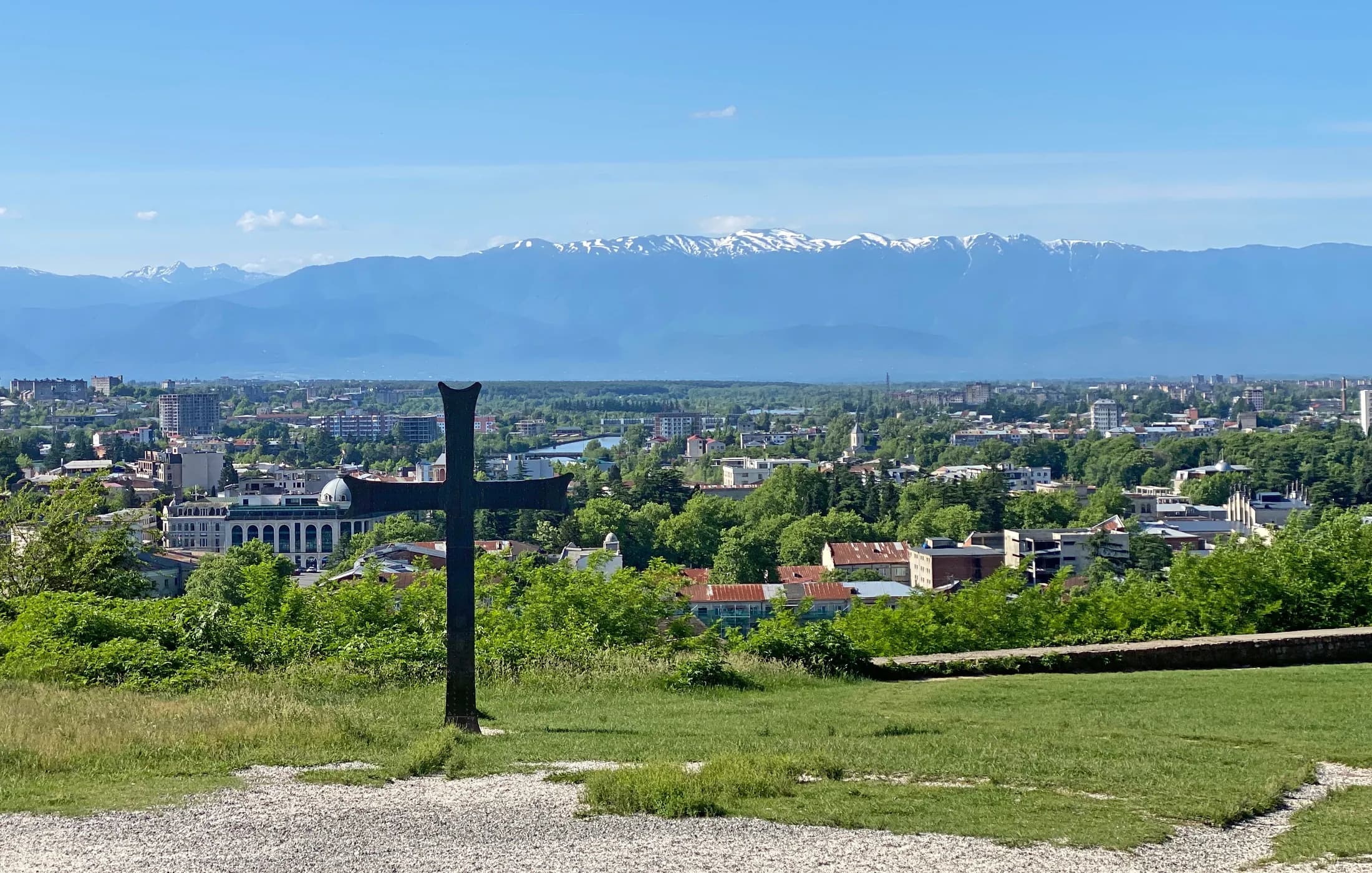
Photo: Bernard Gagnon / Wikimedia Commons / CC BY 4.0, cropped
Kutaisi is one of Georgia’s oldest cities and the cultural heart of Imereti, combining medieval monuments, lively markets, bridges over the Rioni, distinctive western Georgian food and easy access to caves, monasteries, canyons, spa towns and wine country.
Country
Georgia
Type
City
Walking
varies
Where it is
42.2717, 42.7056
Understand the place
Not only where to go, but what to eat, what things cost, what visitors get wrong, how accessible Kutaisi is, which scams to recognize and what is genuinely worth your time.
Planning your visit
April to June and September to October are especially good for combining Kutaisi itself with caves, monasteries and western Georgian day trips. July and August are warm and humid and can be busy at major natural attractions. Winter is much quieter and the city remains visitable, although rain, shorter daylight and seasonal conditions can affect canyon and outdoor excursions.
2–3 days for Kutaisi, Gelati, Motsameta and one nearby natural attraction. Allow 4–5 days if you want to use Kutaisi as a base for Tskaltubo, Prometheus Cave, Sataplia, canyons, wineries or other parts of Imereti.
The historic center around the central boulevard, Colchis Fountain, Green Bazaar and White Bridge is best for first-time visitors who want to explore Kutaisi mostly on foot. Accommodation closer to the Rioni can offer more atmosphere, while properties near major roads may be more convenient for travelers with a car or frequent day trips. Kutaisi International Airport is outside the city, so staying near the airport is usually unnecessary unless you have a very early or late flight.
Kutaisi International Airport — officially David the Builder Kutaisi International Airport — is outside central Kutaisi, near Kopitnari. The airport's own site lists shuttle bus, bus, rail and taxi connections, so check which of them runs at your arrival time before booking an airport hotel or assuming a short hop into town.
Opening conditions at caves, canyon trails and boat sections can change because of weather, water levels, maintenance or seasonal restrictions.
Prometheus Cave, Sataplia, Gelati, Motsameta, Tskaltubo and the canyons are spread across different directions. Combining too many creates more driving than sightseeing.
Kutaisi’s historic center is highly walkable, and central accommodation makes restaurants, markets and local transport much easier.
The complete guide
Start with the parts of Kutaisi that matter most to your trip, then move into the practical details.
Experiences & attractions
Attractions, experiences and places actually worth your time.
Eat like you understand the place
Signature dishes, local drinks, markets and eating well.
Where to stay & explore
Where to stay, wander and choose the right area for your trip.
Beyond the destination
Nearby places worth a day out from here.
Bring home the right things
What is genuinely worth buying and where to look.
After dark
What the evenings are like, and where to spend them.
Family travel
Family logistics, strollers, transport and practical planning.
When to go
When to visit and what the seasons really feel like.
Know before it happens
Common tourist traps and how to avoid them.
Money & budgeting
Budgets, payments and everyday prices.
Transport
Public transport, taxis, walking and common pitfalls.
Travel for more people
Mobility, transport and sensory accessibility.
Understand before you arrive
Local expectations, religion and visitor etiquette.
The details that matter
Connectivity, health, photography and useful local details.
Find your fit
Solo, women alone, older visitors, LGBTQ+, pets, remote work, budget and luxury.
Travel that holds up
Tourism pressure, supporting local people and animal welfare.
Things to do
Built at the beginning of the 11th century under King Bagrat III, Bagrati Cathedral stands above Kutaisi on Ukimerioni Hill and is closely associated with the political unification of medieval Georgia. It was inscribed on the UNESCO World Heritage List with Gelati in 1994 and removed from it in 2017, after a reconstruction that UNESCO judged to have compromised its integrity and authenticity. Gelati remains inscribed.
The iron bridge over the Rioni dates to 1872 and is one of Kutaisi’s most recognizable urban landmarks. Its name reflects the pale stones visible in the river below.
A small statue beside the White Bridge references a famous character from the Georgian film An Unusual Exhibition and the local tradition known as 'Baptism as a Kutaisian' — jumping from the bridge into the Rioni.
Kutaisi’s central fountain is decorated with enlarged golden figures based on archaeological artifacts uncovered at Vani, visually connecting modern Kutaisi with ancient Colchis and the wider Golden Fleece tradition.
The garden boulevard has long been part of the city’s social life. Georgian poet Akaki Tsereteli famously called it the 'Parliament of Kutaisi' because local intellectuals gathered here to debate politics and public affairs.
A working market with deep roots in the city’s social life, selling fruit, vegetables, herbs, dairy products, meat, dried fruit, churchkhela, tklapi and homemade sauces.
Food & drink
Kutaisi is one of Georgia’s strongest food destinations because Imeretian cooking is distinctive even within Georgian cuisine. It is especially associated with fresh herbs, wild greens, poultry, walnuts, Imeretian cheese, thin khachapuri and highly seasonal sauces. Some of the region’s most interesting dishes are less likely to appear on generic tourist menus, making family restaurants and seasonal cooking particularly rewarding.
The round, cheese-filled Imeretian version is often described as the 'mother of khachapuri' because it is the most widespread Georgian style. A good version has thin, delicate dough and fresh, lightly salty Imeretian cheese.
In older Imeretian practice, khachapuri was baked in a clay pan called a ketsi over embers. Some traditional methods also used dried bay-cherry leaves around the bread during baking.
A distinctive Imeretian preparation combining poultry with a sweet-sour sauce made from unripe grapes and blackberries, often with herbs, garlic and spices.
An Imeretian tradition built around mixtures of seasonal wild greens. Traditional versions can combine numerous plants such as nettles, primroses, mallows, amaranth and other spring herbs.
Tender spring shoots of the thorny smilax plant are cooked and dressed with herbs, vinegar and often walnuts or hazelnuts. It is particularly associated with western Georgian cooking.
A fresh, lightly salty cow’s-milk cheese with a soft, slightly squeaky texture. It is central to Imeretian khachapuri and commonly eaten with mchadi or other dishes.
Safety & tourist traps
Kutaisi is generally straightforward for visitors, and ordinary tourist crime is not the city’s defining risk. More common practical problems involve road crossings, confusing airport logistics, slippery river or cave environments, weather-dependent canyon trips and travelers attempting to combine too many distant attractions in one day.
Street taxis without app-displayed fares can quote significantly different prices.
Avoid it: Use a reputable ride-hailing app where available or agree the full fare before departure.
Visitors sometimes assume Kutaisi International Airport is within the central city and accept unnecessary or overpriced arrangements.
Avoid it: Check the airport’s actual location and current bus, shuttle, rail or taxi options before arrival.
Some itineraries promise too many caves, monasteries and canyons in one day, leaving most of the time for driving.
Avoid it: Check actual driving times and entrance duration rather than counting only the number of stops.
Shopping & souvenirs
Wine made from indigenous western Georgian grapes provides a more region-specific souvenir than generic Georgian wine.
Where to buy: Wine shops or directly from reputable Imeretian wineries.
Fresh local cheese is central to Imeretian cooking.
Where to buy: Kutaisi Green Bazaar or specialist food shops.
Traditional grape-and-nut sweets and fruit leather are easy to transport when properly packaged.
Where to buy: Green Bazaar and established food shops.
Small handmade objects are sold in the center and at markets.
Where to buy: Craft shops and local makers.
Money & costs
Georgia uses the Georgian lari (GEL). Cards are widely accepted in central hotels, supermarkets, restaurants and larger businesses, while cash remains useful at the Green Bazaar, bakeries, small cafes, marshrutkas and rural day-trip stops. ATMs are common in central Kutaisi. Carry some cash before heading to smaller villages or wineries.
Transport
Kutaisi’s central historic area is compact and highly walkable. City buses, minibuses and taxis cover the wider urban area. Gelati, Motsameta, Sataplia, Prometheus Cave, Tskaltubo and the canyons require separate transport planning. Kutaisi International Airport is outside the city, and airport shuttle, bus, rail-transfer and taxi options should be checked against your actual flight schedule.
Arrival airport
Kutaisi International AirportKUT
The airport sits about twelve kilometres west of Kutaisi itself, so arriving is always followed by a road leg however short. Onward transport is arranged on the day rather than booked through XTOUR: check the airport's own site for current bus connections, and expect car hire and taxis to be the practical options for reaching places outside the city.
Accessibility
Central Kutaisi is relatively manageable compared with Georgia’s mountain destinations, but accessibility remains inconsistent. The flatter boulevard and central streets are easier, while Bagrati, monasteries, caves, canyon infrastructure and older buildings create more significant barriers.
Wheelchair access
Some central public spaces and newer businesses are reasonably accessible, but continuous step-free routes cannot be assumed.
Family travel
Kutaisi works particularly well for families because the city itself is manageable and nearby attractions include dinosaur footprints, caves, parks and relatively short sightseeing journeys.
What visitors get wrong
The city has its own historic identity, food culture, museums and neighborhoods and is one of the strongest bases for exploring western Georgia.
It was, jointly with Gelati, from 1994. UNESCO removed Bagrati from the list in 2017 after a reconstruction it judged damaging to the building's integrity and authenticity. Gelati kept its inscription and was taken off the List of World Heritage in Danger in the same year. Bagrati is still very much worth visiting; the guidebooks and signage that still call it a World Heritage Site are simply out of date.
Prometheus is much larger and focused on spectacular underground formations, while Sataplia combines a shorter cave experience with dinosaur footprints, forest and panoramic viewpoints.
The tradition is part of Kutaisi folklore and local identity. The Rioni is a powerful river and the story should be appreciated culturally rather than imitated.
Imeretian khachapuri has its own cheese, proportions and historic ketsi-baking tradition and is regarded as the foundational Georgian style.
The region’s monasteries, caves, spa towns and canyons are spread in different directions. Two well-chosen areas are usually more satisfying than six rushed stops.
Traveler experiences
Traveler reviews will appear here after moderation.
Nearby
Smaller places within reach of Kutaisi — worth the detour, but not the kind of stop that gets its own guidebook chapter.
Worth the drive
Distances are straight-line, not driving time — mountain roads in this region are often twice as long as the map suggests.
Synagogue · Kutaisi, Imereti
Kutaisi's main synagogue, built in 1886 on Boris Gaponov Street in the historic Jewish quarter, with an ornamented stone façade opening onto the street through a triple arcade and a painted interior.
Church · Kutaisi (Ukimerioni Hill), Imereti
Bagrat III's cathedral on Ukimerioni Hill in Kutaisi, left in ruins after an Ottoman attack in the late 17th century and rebuilt in 2010.
Monastery · Motsameta, Imereti
A small monastery on a rock promontory in a bend of the Tskaltsitela river, a few kilometres from Kutaisi and usually visited on the way to Gelati.
Cave · Banoja, Imereti
A karst cave and a set of fossil dinosaur footprints in a wooded reserve on the edge of Kutaisi, with a glass viewing platform out over the Imereti hills.
Monastery · Gelati, Imereti
The twelfth-century monastery and medieval academy founded by David the Builder above Kutaisi, and the only UNESCO World Heritage site in western Georgia.
Cave · Imereti
A karst show cave just outside the spa town of Tskaltubo, opened to visitors in 2021, with stalactites, stalagmites and helictites and a wine store kept at the cave's steady temperature.
Explore deeper
9 guides
Cloisonne enamel, pottery you will actually cook in, felt, an original artwork, something older: they are different purchases with different questions. This guide separates the object from the maker from the buying format, and covers the parts that only become urgent at the airport — packing, shipping, and whether an older object may legally leave.
Georgia offers more photographic subjects than a trip can hold, which is why a viewpoint list is the wrong tool. This guide starts from the subject — city, landscape, heritage, village, wildlife, food and craft, night sky, drone — and treats access, permission, light and fallback as separate questions with separate answers.
A ramp is evidence about one door. This guide plans a Georgian trip as a chain — transport, accommodation, entrance, the activity, toilets and rest, a meal, the return — and starts by describing the traveller precisely enough that a venue can give a useful answer instead of a label.
A cheap intercity fare is not a cheap journey if it ends a taxi ride from where you needed to be, with luggage, after the last local connection. This guide compares whole journeys — endpoints, last mile, booking channel, what happens when you miss a departure, and the return — rather than modes.
The attraction is rarely the problem; the activity inside it is. A canyon that works for a family on foot may sell a boat ride with a minimum age nobody mentioned until the desk. This guide checks the activity rather than the attraction, and adds up what a day costs for everyone rather than what a child ticket saves.
Most first trips to Georgia fail the same way: too many famous places, too little thought about which of them the group will actually enjoy. This guide picks one anchor base and one contrasting experience, sets out six trip shapes, and deliberately pushes past the Tbilisi–Mtskheta–Kakheti circuit to the archaeology, the south and the west.
Georgia and Armenia get compared constantly and chosen badly, usually on the assumption that they are near-identical neighbours. They are not. The clearest differences are in how a trip is actually shaped — where you sleep, how often you move — and in what each country has most of. This guide sets out the ones XTOUR can support with published records, and declines the ones it cannot.
Georgia has kept a great deal of medieval religious architecture, and the surviving churches and monasteries are not interchangeable. This guide explains how the major sites differ — cathedral, monastery, cave complex — what UNESCO has and has not inscribed, where they cluster, and how to pick the handful that suit the trip you are actually taking.
Georgia is small on a map and slow on the ground, and the usual mistake is booking a week and planning three weeks of sightseeing. This guide works from the stay XTOUR recommends for each base — a minimum, and what the extra days buy — so you can decide how long you need by choosing bases rather than by counting sights.
Continue exploring