Park · Imereti
Borjomi-Kharagauli National Park
A large protected area of conifer and mixed forest in the Lesser Caucasus between Borjomi and Kharagauli, crossed by marked trails with tourist shelters and campsites.
21 km in a straight line
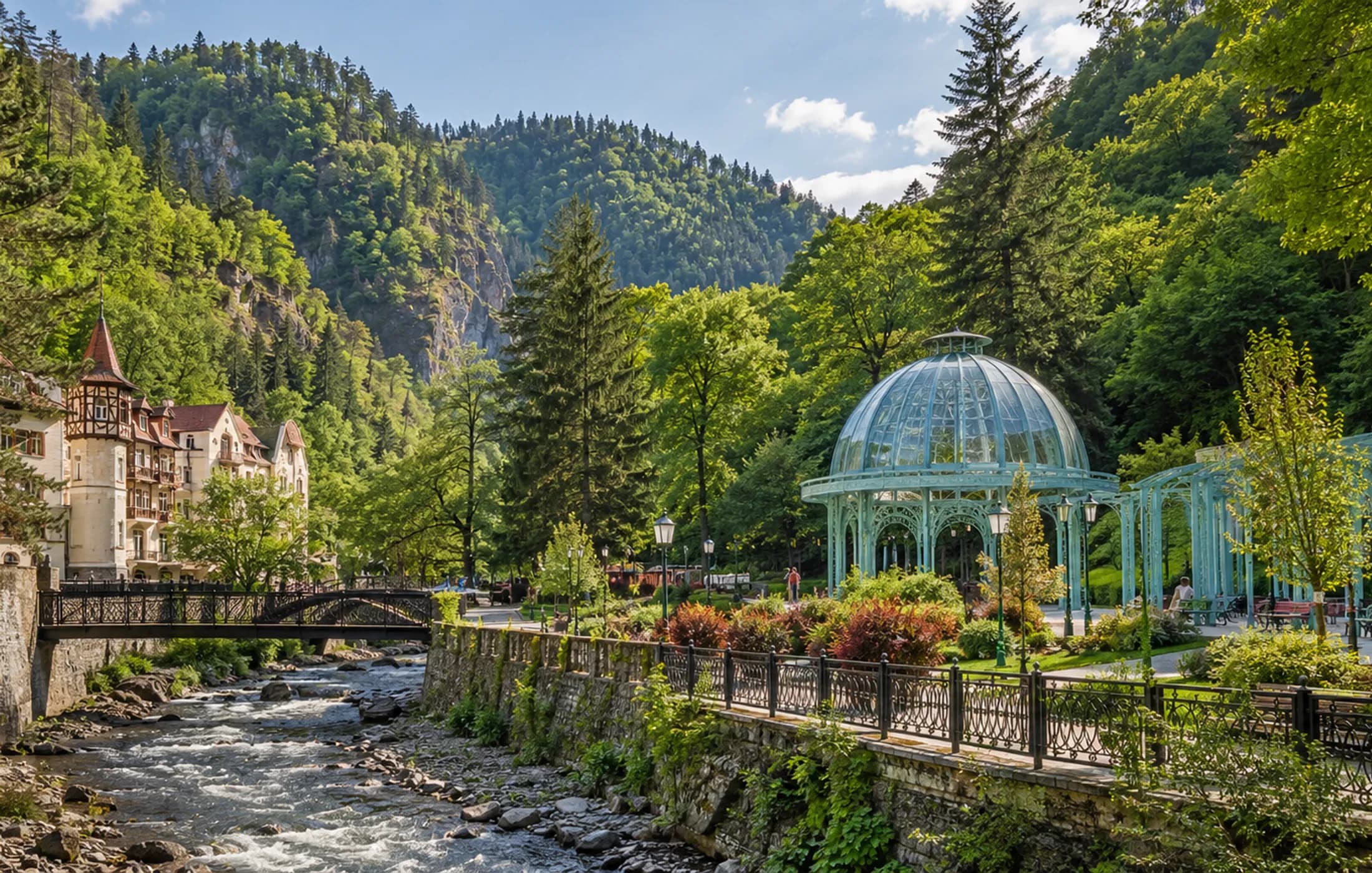
Illustration — not a photograph of this place
Borjomi is Georgia’s best-known mineral-water resort, set in a forested valley of the Lesser Caucasus and known for its historic spa culture, Central Park springs, Romanov-era architecture, sulfur pools and access to Borjomi-Kharagauli National Park.
Country
Georgia
Type
Town
Walking
varies
Where it is
41.8417, 43.3828
Understand the place
Not only where to go, but what to eat, what things cost, what visitors get wrong, how accessible Borjomi is, which scams to recognize and what is genuinely worth your time.
Planning your visit
May to October is the easiest period for walking, spa activities and national-park excursions. July and August are the busiest summer months. Autumn is especially attractive for forest color, while winter is quiet and atmospheric and works well for a spa-focused stay, although hiking conditions become more demanding. Snow is possible in the colder months and higher trails can remain wintry well into spring.
2–3 days for Borjomi itself, Central Park, the sulfur pools and nearby historical sights. Stay 4–5 days if you want to combine the town with serious hiking in Borjomi-Kharagauli National Park, Bakuriani, Likani or more remote parts of Samtskhe-Javakheti.
Central Borjomi near the park and main town streets is the most convenient choice for first-time visitors and travelers without a car. Likani offers a quieter, more resort-like atmosphere west of the center. Travelers planning multi-day national-park hikes should prioritize access to the visitor center and trail transport rather than choosing accommodation only by spa facilities.
Borjomi is both a resort town and a gateway to a huge national park. Trying to combine a long trail with sulfur pools and city sightseeing in one day usually results in rushing.
Borjomi-Kharagauli National Park requires visitors to register at its visitor center before entering the trail network. Confirm current trail, shelter and weather conditions there before departure.
Historic railway and resort transport services can change schedules or suspend operation. Do not build an itinerary around a specific train or lift without confirming it.
Borjomi is popular with Georgian domestic travelers as well as international visitors, so well-rated hotels and spa properties can fill on summer weekends and holidays.
The complete guide
Start with the parts of Borjomi that matter most to your trip, then move into the practical details.
Experiences & attractions
Attractions, experiences and places actually worth your time.
Eat like you understand the place
Signature dishes, local drinks, markets and eating well.
Where to stay & explore
Where to stay, wander and choose the right area for your trip.
Beyond the destination
Nearby places worth a day out from here.
Bring home the right things
What is genuinely worth buying and where to look.
After dark
What the evenings are like, and where to spend them.
Family travel
Family logistics, strollers, transport and practical planning.
When to go
When to visit and what the seasons really feel like.
Know before it happens
Common tourist traps and how to avoid them.
Money & budgeting
Budgets, payments and everyday prices.
Transport
Public transport, taxis, walking and common pitfalls.
Travel for more people
Mobility, transport and sensory accessibility.
Understand before you arrive
Local expectations, religion and visitor etiquette.
The details that matter
Connectivity, health, photography and useful local details.
Find your fit
Solo, women alone, older visitors, LGBTQ+, pets, remote work, budget and luxury.
Travel that holds up
Tourism pressure, supporting local people and animal welfare.
Things to do
The historic heart of Borjomi, set in a narrow forested valley along the Borjomula River. The park contains walking paths, rides, cafes, mineral springs and the starting path toward the sulfur pools.
The best-known drinking spring in Borjomi Central Park. Visitors can taste Borjomi mineral water directly from the source. The spring water is warm and is not naturally sparkling in the same way as bottled Borjomi.
Borjomi’s mineral-water industry developed into a major commercial enterprise in the late 19th century. The first bottling plant was established in 1890, helping turn the town’s name into one of Georgia’s most internationally recognized products.
A series of outdoor warm sulfur pools in the forest beyond Central Park. They are reached by continuing roughly two kilometres along the valley path past the developed park area.
One of Georgia’s older regional museums, housed in an ornate 1890 building originally associated with the Romanov imperial administration. Its collections cover archaeology, ethnography, natural history, art and objects connected with Borjomi’s resort history.
A quieter resort area just west of Borjomi, historically chosen as a summer retreat by the Russian imperial family and later used by Soviet political elites.
Food & drink
Borjomi sits in Samtskhe-Javakheti, so travelers who look beyond standard resort menus can explore one of Georgia’s most distinctive regional cuisines. Meskhetian cooking is rich in preserved meats, wheat-based breads, unusual cheeses, mulberry products and dishes that are rarely found elsewhere in Georgia.
A technically demanding layered form of khachapuri made with very thin dough, fat and Meskhetian cheeses. It is also known as chalma khachapuri because of its turban-like form and is recognized as part of Georgia’s intangible cultural heritage.
A highly distinctive Meskhetian khinkali made with salted, dried goose meat. Unlike standard Georgian khinkali, the dough pieces are rectangular and the dish is cooked in a rich broth.
A labor-intensive Meskhetian string cheese made from cow or sheep milk, stretched into fine strands, dried and packed tightly with cream into clay vessels. Its traditional production method is recognized as intangible cultural heritage.
Concentrated mulberry juice sometimes called Meskhetian honey, used historically in sweets and festive preparations.
A rich filled pastry with deep roots in Meskhetian festive cooking.
Safety & tourist traps
Borjomi itself is generally easy to navigate, but outdoor risks become much more important once travelers enter the national park. Weather, steep trails, long distances, snow, limited mobile coverage and underestimating hiking difficulty are more significant concerns than ordinary tourist crime.
Short transfers to Likani, trailheads or nearby monasteries may not have fixed public fares.
Avoid it: Agree the fare and waiting time before departure or use a reputable app when available.
Some routes are presented casually even though they involve long distances, steep ascent or overnight hiking.
Avoid it: Check the official trail length, difficulty and current conditions at the visitor center before departing.
Likani and other heritage buildings can have changing access conditions.
Avoid it: Confirm current public access rather than paying for transport based solely on old online photographs.
Shopping & souvenirs
Vintage-style bottles, labels and imagery connected with the mineral-water brand reflect the town’s unusual industrial and spa history.
Where to buy: Souvenir shops in central Borjomi.
A distinctive Meskhetian string cheese with an ancient preparation tradition.
Where to buy: Specialty producers and food stores in the wider region.
Bakmazi, preserves and other mulberry products are strongly connected with southern Georgian food traditions.
Where to buy: Local producers and regional food shops.
Money & costs
Georgia uses the Georgian lari (GEL). Cards are common in hotels, supermarkets and established restaurants in Borjomi, but cash is useful for guesthouses, local transport, markets, small food shops and some trail-related services. Travelers heading into the national park should carry enough cash before leaving town.
Transport
Central Borjomi is walkable, although the valley is steep and some accommodation sits well above the main streets. Local taxis are useful for Likani, monasteries and trailheads. Public road transport connects Borjomi with Tbilisi and regional towns. The famous narrow-gauge railway toward Bakuriani is part of the town’s heritage, but travelers should verify whether and when passenger service is operating rather than assuming a daily schedule.
Accessibility
Borjomi can provide a meaningful visit without serious hiking, especially around Central Park and resort hotels, but the steep valley, older buildings and forest routes create barriers. National-park trails are generally unsuitable for travelers requiring continuous step-free access.
Wheelchair access
Central park areas and larger hotels may be manageable, but continuous accessible routes through the town should not be assumed.
Family travel
Borjomi works well for families because Central Park, mineral springs, forest walks and sulfur pools can be combined without committing to serious mountain trekking.
What visitors get wrong
Borjomi is a historic spa town with parks, imperial-era architecture, sulfur pools, museums and access to one of Georgia’s largest national parks.
Spring water is warm and naturally mineralized but is not presented with the same carbonation as the bottled product.
It is a vast protected area covering multiple districts, with numerous trailheads and day-to-multi-day routes.
The narrow-gauge railway is a famous part of Borjomi’s identity, but actual passenger operation should be checked before relying on it.
The wider Samtskhe-Javakheti region has unusually specific Meskhetian foods including goose apokhti, tenili cheese, layered khachapuri and mulberry bakmazi.
Traveler experiences
Traveler reviews will appear here after moderation.
Worth the drive
Distances are straight-line, not driving time — mountain roads in this region are often twice as long as the map suggests.
Park · Imereti
A large protected area of conifer and mixed forest in the Lesser Caucasus between Borjomi and Kharagauli, crossed by marked trails with tourist shelters and campsites.
Fortress · Atskuri, Samtskhe-Javakheti
A cliff-top fortress over the Mtkvari at Atskuri village, long a defensive post for the Borjomi valley, with a narrow tunnel cut down to the riverbank so the garrison could reach water during sieges.
Lake · Samtskhe-Javakheti
A high lake at 2,000 metres in Samtskhe-Javakheti holding some 221 million cubic metres of water, with Tabatskuri village built out on a small peninsula along its shore.
Monastery · Ubisi, Imereti
A ninth-century monastery at Ubisi in Kharagauli municipality, pairing a hall church painted in the fourteenth century with a four-storey tower dated 1141.
Craft market · Imereti
The roadside market of Shrosha's potters, now trading from purpose-built areas on both sides of the new East–West motorway near the village, selling hand-thrown clay pots, jugs and qvevri.
Monastery · Ghrele, Samtskhe-Javakheti
A working monastery screened by forest and yellowish cliffs near the village of Ghrele outside Akhaltsikhe, where the domed thirteenth-century Church of St Saba stands beside a tenth-century Dormition church.
Explore deeper
2 guides
Georgia is small on a map and slow on the ground, and the usual mistake is booking a week and planning three weeks of sightseeing. This guide works from the stay XTOUR recommends for each base — a minimum, and what the extra days buy — so you can decide how long you need by choosing bases rather than by counting sights.
Samtskhe-Javakheti has two landscapes: the Mtkvari river gorge, lined with fortresses and ending at the cave monastery of Vardzia, and the Javakheti volcanic plateau, whose lakes sit at around 2,000 metres. Five sites lie within 39.9 km of one another in a straight line, and the plateau has a hillfort of the second millennium BCE on a mountain summit.
Continue exploring