Practical Travel Informationin Borjomi
Practical information for visiting Borjomi, including connectivity, health considerations, photography, tourist mistakes and useful local knowledge.
Practical information
The details that make Borjomi easier
Connectivity, health considerations, photography and the little things travelers often only discover after arrival.
Connectivity
SIM / eSIM
Mobile coverage is generally reliable in Borjomi town but can weaken in deep forest and remote national-park valleys. Download offline maps before serious hikes.
Wi-Fi
Wi-Fi is common in hotels, guesthouses and cafes.
Plug type
Type C and Type F
Voltage
220V, 50Hz
Health & practical risks
Long national-park routes
Some official trails take two to four days and cross remote terrain. Do not treat them as casual city walks.
Trail weather
Conditions in higher parts of Borjomi-Kharagauli can be much colder and wetter than in town.
Limited mobile signal
Coverage can disappear in valleys and forest. Registering at the visitor center and carrying offline navigation are important.
Sulfur pool heat
Warm thermal pools can cause dizziness or dehydration if you remain in them too long. Enter gradually and take breaks.
Old buildings and ruins
Historic and Soviet-era structures may be unstable or privately controlled. Do not enter closed areas.
What tourists often get wrong
Borjomi is only the name of bottled mineral water.
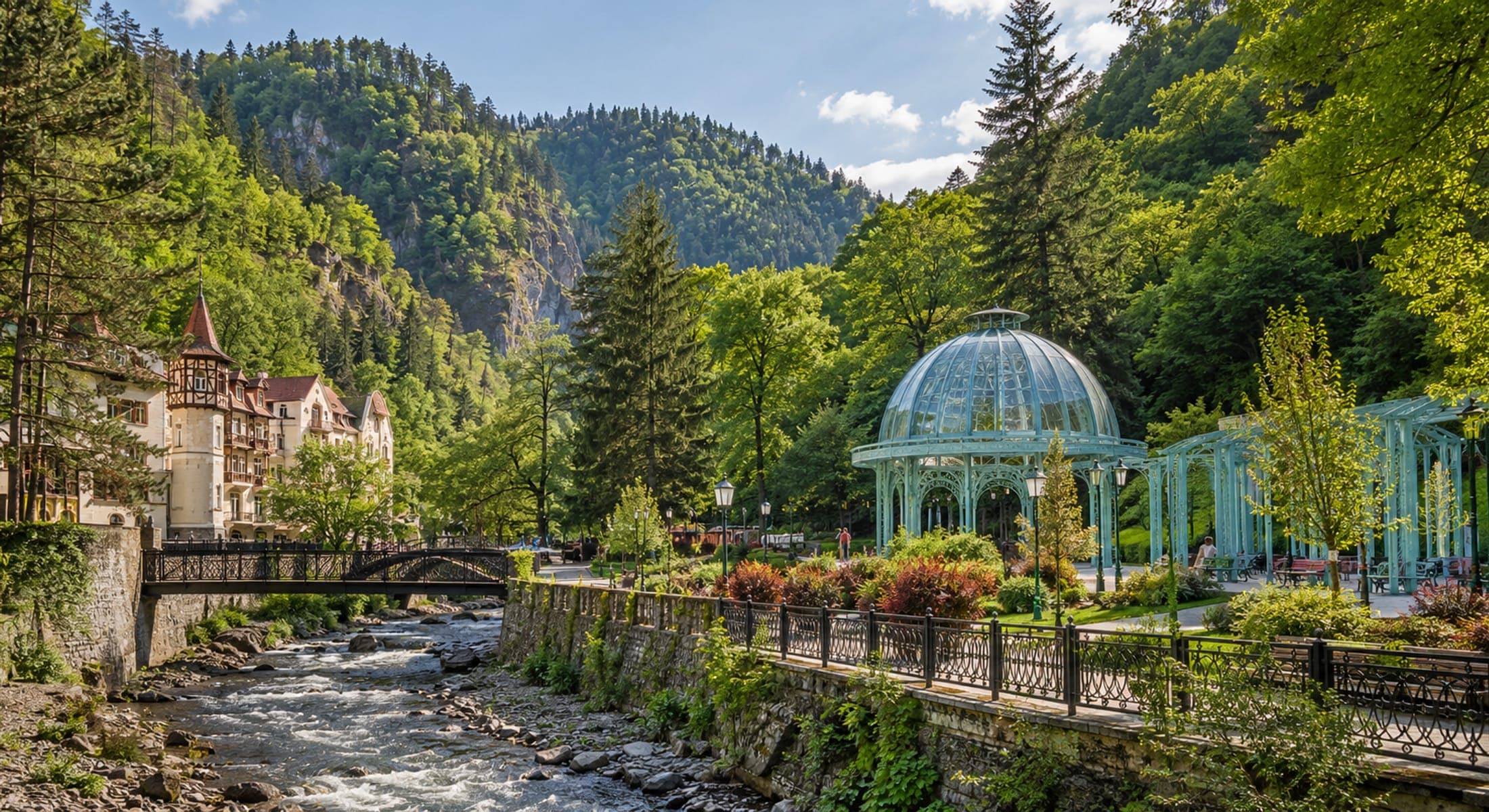
Borjomi is a historic spa town with parks, imperial-era architecture, sulfur pools, museums and access to one of Georgia’s largest national parks.
The mineral water in the spring should taste exactly like bottled Borjomi.
Spring water is warm and naturally mineralized but is not presented with the same carbonation as the bottled product.
Borjomi-Kharagauli National Park is one trail just outside town.
It is a vast protected area covering multiple districts, with numerous trailheads and day-to-multi-day routes.
The Kukushka train always runs on a tourist timetable.
The narrow-gauge railway is a famous part of Borjomi’s identity, but actual passenger operation should be checked before relying on it.
Borjomi’s regional food is basically standard Georgian cuisine.
The wider Samtskhe-Javakheti region has unusually specific Meskhetian foods including goose apokhti, tenili cheese, layered khachapuri and mulberry bakmazi.
Continue planning
More about Borjomi
Experiences & attractions
Things to Do
What there is to do in Borjomi: the major sights, local experiences and the practical detail you need to plan around them.
Eat like you understand the place
Food
What to eat and drink in Borjomi, from signature dishes and local drinks to markets, dietary needs and restaurant etiquette.
Know before it happens
Scams
Common scams, tourist traps and avoidable problems in Borjomi, with practical advice on how travelers can recognize and avoid them.
Bring home the right things
Souvenirs
What to buy in Borjomi, where to shop, typical prices, authenticity advice and which souvenirs are genuinely connected to the destination.
When to go
Weather
A month-by-month guide to weather, crowds and seasonal conditions in Borjomi, and how to choose when to go.
Family travel
With Kids
Visiting Borjomi with babies, toddlers, children and teenagers, including strollers, car seats and changing facilities.
Travel for more people
Accessibility
Accessibility information for Borjomi, including walking difficulty, wheelchair access, transport, stairs, seating and sensory considerations.
After dark
Nightlife
A practical introduction to nightlife in Borjomi, including nightlife areas, atmosphere, late-night considerations and safety.
Complete destination guide