Martvili Day Trip
A guided day trip taking in Martvili Canyon. Check the current itinerary and booking details on SkyGate.
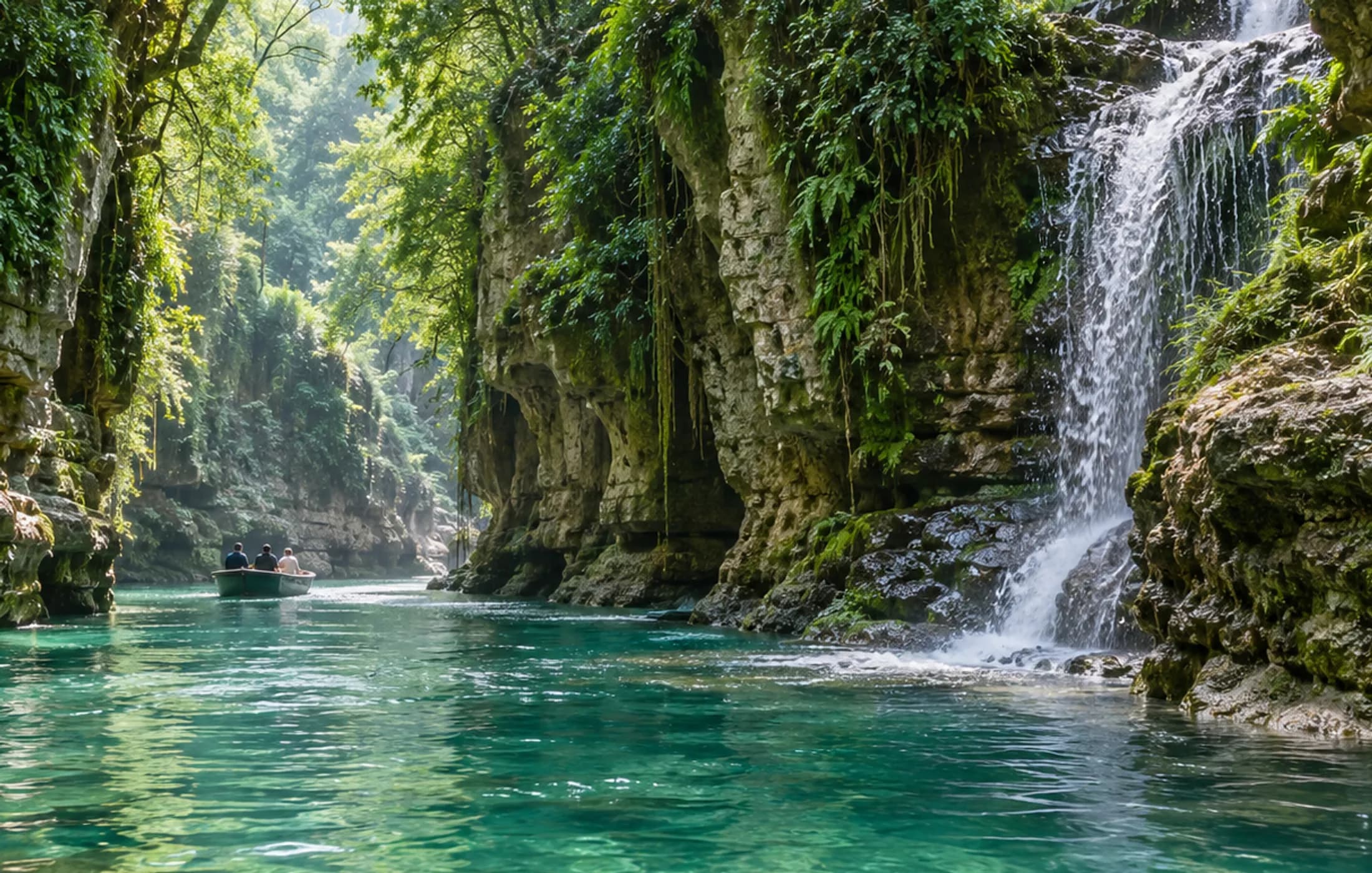
Illustration — not a photograph of this place
Martvili is a small town in Samegrelo surrounded by limestone canyons, waterfalls, forested river valleys, historic churches and some of western Georgia's most distinctive Megrelian food traditions.
Country
Georgia
Type
Town and Nature Base
Walking
varies
Where it is
42.4148, 42.3789
Understand the place
Not only where to go, but what to eat, what things cost, what visitors get wrong, how accessible Martvili is, which scams to recognize and what is genuinely worth your time.
Planning your visit
May to October is the easiest period for canyon walks, waterfalls and rural excursions. June through September is warm and lush but also humid, with sudden rain possible. Spring is especially green, while autumn brings quieter conditions and softer light. Winter is calm and atmospheric, but some nature attractions may operate reduced hours or be affected by weather.
1–2 days is enough for Martvili Canyon, the monastery and nearby waterfalls. Stay 3 days if you want to explore Balda, hot springs, rural villages and Megrelian food at a slower pace instead of treating Martvili as only a quick stop from Kutaisi.
Central Martvili is practical for shops, restaurants and local transport, while guesthouses in nearby villages offer more rural atmosphere and easier access to waterfalls and countryside. Travelers without a car should confirm transport options before choosing remote accommodation.
Boat rides and visitor routes can be affected by heavy rain, high water levels or maintenance. Check current operating conditions before building the day around the canyon.
Many of the area's best waterfalls, villages and natural sites are outside the town itself and require separate transport.
Martvili Canyon, Balda and rural waterfalls can be combined more efficiently than pairing Martvili with attractions far across Samegrelo.
Public transport is workable for reaching Martvili, but private transport becomes much more useful once you want to visit waterfalls, springs and smaller villages.
The complete guide
Start with the parts of Martvili that matter most to your trip, then move into the practical details.
Experiences & attractions
Attractions, experiences and places actually worth your time.
Eat like you understand the place
Signature dishes, local drinks, markets and eating well.
Where to stay & explore
Where to stay, wander and choose the right area for your trip.
Beyond the destination
Nearby places worth a day out from here.
Bring home the right things
What is genuinely worth buying and where to look.
After dark
What the evenings are like, and where to spend them.
Family travel
Family logistics, strollers, transport and practical planning.
When to go
When to visit and what the seasons really feel like.
Know before it happens
Common tourist traps and how to avoid them.
Money & budgeting
Budgets, payments and everyday prices.
Transport
Public transport, taxis, walking and common pitfalls.
Travel for more people
Mobility, transport and sensory accessibility.
Understand before you arrive
Local expectations, religion and visitor etiquette.
The details that matter
Connectivity, health, photography and useful local details.
Find your fit
Solo, women alone, older visitors, LGBTQ+, pets, remote work, budget and luxury.
Travel that holds up
Tourism pressure, supporting local people and animal welfare.
Things to do
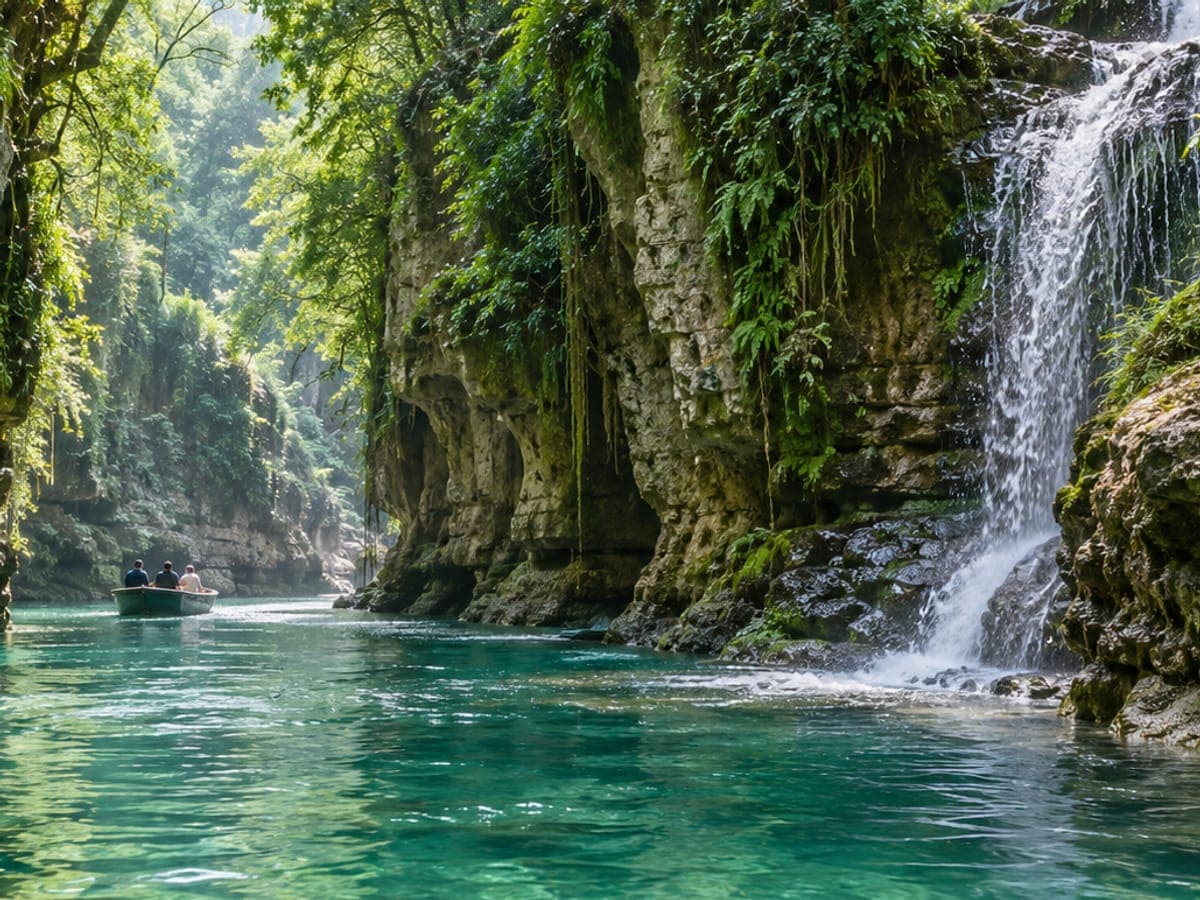
A narrow limestone canyon carved by the Abasha River, known for turquoise-green water, forested cliffs, waterfalls and a developed visitor route that can include short boat sections when conditions allow.
A major religious complex standing on a hill above the town, associated with long periods of Georgian ecclesiastical history and with panoramic views over Samegrelo.
The Abasha River shapes much of Martvili's landscape, feeding the canyon and passing through lush limestone terrain typical of western Georgia.
A less urbanized canyon landscape near the village of Balda, known for forest, limestone formations, river scenery and smaller-scale nature experiences compared with Martvili Canyon.
A quieter waterfall destination in the Martvili municipality, surrounded by dense vegetation and rural landscapes.
Warm mineral springs in the wider Martvili area are used locally for bathing and relaxation, though facilities are far simpler than a conventional spa resort.
Food & drink
Martvili is in Samegrelo, one of Georgia's most distinctive food regions. Megrelian cuisine is known for bold spice, adjika, corn-based dishes, cheese, walnuts, herbs and rich sauces. Travelers who eat only generic Georgian dishes miss a large part of what makes Martvili culturally different from Kutaisi or Tbilisi.
One of Samegrelo's defining dishes, made by slowly working cornmeal together with large amounts of stretchy cheese until the mixture becomes elastic and rich.
Soft cheese rolled with mint and served in a milky or yogurt-like sauce, producing a distinctive fresh and aromatic Megrelian flavor.
Unlike Imeretian khachapuri, the Megrelian version is filled with cheese and also topped with additional cheese before baking.
A strongly seasoned sausage traditionally associated with western Georgian cooking and often served grilled or fried.
Beans, corn bread and spicy Megrelian condiments form a simple but highly regional combination.
A powerful paste or seasoning built around chili, garlic, herbs and spices and used widely throughout Samegrelo.
Safety & tourist traps
Martvili is generally calm and straightforward. The main risks are related to slippery canyon surfaces, fast rivers, sudden heavy rain, rural roads and visitors entering undeveloped waterfalls or swimming areas without understanding current conditions.
Drivers may quote only the first transfer rather than a full multi-stop route.
Avoid it: Agree all stops, waiting time and return journey before departure.
Visitors may be offered access to remote waterfalls or swimming spots without clear information about trail conditions.
Avoid it: Ask guesthouses or established local guides about current access and avoid routes that become dangerous after rain.
Old travel posts may describe boat routes or access conditions that are temporarily unavailable.
Avoid it: Check current conditions directly before traveling.
Shopping & souvenirs
One of the region's strongest food souvenirs and an excellent way to take Megrelian flavor home.
Where to buy: Markets, local producers and food shops.
A regionally meaningful wine souvenir connected with Samegrelo.
Where to buy: Reputable western Georgian wineries and wine shops.
Western Georgian cheeses pair closely with regional dishes such as elarji and gebzhalia.
Where to buy: Markets and local dairy producers.
Money & costs
Georgia uses the Georgian lari (GEL). Cards are accepted at many established hotels and restaurants, but cash remains useful for guesthouses, local drivers, markets and rural stops. Carry cash before heading into smaller villages.
Transport
Central Martvili is small, but the wider municipality is spread across villages, canyons and waterfalls. Public transport is sufficient for reaching the town from larger cities, while a taxi, private driver or rental car is far more useful for exploring rural attractions efficiently.
Arrival airport
Kutaisi International AirportKUT
Kutaisi International is the arrival airport, about forty-five kilometres away on made roads. It is the primary hub because of its network and its road rather than because it is nearest — Batumi is further and the road is slower.
Accessibility
Martvili town itself is relatively manageable, but the destination's strongest natural attractions involve stairs, wet surfaces and undeveloped terrain. Travelers with mobility limitations can still enjoy viewpoints, monastery visits and rural drives with careful planning.
Wheelchair access
Continuous wheelchair access is limited at canyon and waterfall attractions.
Family travel
Martvili works well for families who enjoy nature, but canyon stairs, water and slippery surfaces mean active supervision is important.
What visitors get wrong
The municipality includes monasteries, villages, waterfalls, hot springs, rivers and some of the strongest Megrelian food culture in western Georgia.
Boat routes and visitor access can change with water levels, rain and maintenance.
Samegrelo has its own culinary structure built around corn, cheese, adjika, walnuts, herbs and distinctive dishes such as elarji and gebzhalia.
Many rural waterfalls have limited infrastructure, muddy approaches and no formal safety management.
Village roads, rain and narrow rural routes can make short distances take considerably longer.
Traveler experiences
Traveler reviews will appear here after moderation.
Ways to visit
Bookable trips related to this destination, for when you are ready to move from research to planning.
A guided day trip taking in Martvili Canyon. Check the current itinerary and booking details on SkyGate.
Nearby
Smaller places within reach of Martvili — worth the detour, but not the kind of stop that gets its own guidebook chapter.
Waterfall
A moss-covered waterfall in the Abasha valley near Balda, twenty minutes on foot from Balda Monastery and a short drive from Martvili Canyon.
Waterfall
A 67-metre waterfall in the Toba gorge above Balda, fed by an underground river that emerges from a cave, reached on a half-day forest walk from Balda Monastery.
Worth the drive
Distances are straight-line, not driving time — mountain roads in this region are often twice as long as the map suggests.
Canyon · Gachedili, Samegrelo-Zemo Svaneti
A limestone canyon on the Abasha river near Gachedili, with a walkway along the water and short boat trips through the narrow section.
Canyon · Second Balda, Samegrelo-Zemo Svaneti
A narrow limestone canyon cut by the Abasha river near Second Balda in Martvili municipality — about 1.4 km long, 5–10 m wide and 25–30 m deep — protected as a natural monument.
Waterfall · Samegrelo-Zemo Svaneti
The protected waterfall at the source of the Abasha river in Martvili Municipality, falling off Late Cretaceous limestone on the flank of the Askhi massif into a round plunge hole about 12 metres across.
Archaeological site · Nokalakevi, Samegrelo-Zemo Svaneti
The ruined fortified town of Tsikhegoji, called Archaeopolis by Byzantine writers, in a loop of the Tekhuri river in Samegrelo; now a museum-reserve with walls, Roman-style baths and a 6th-century church.
Church · Tsalenjikha, Samegrelo-Zemo Svaneti
A cross-domed stone cathedral in the Samegrelo town of Tsalenjikha, painted inside by Manuel Eugenicos, a master from Constantinople invited by the ruler Vamek I Dadiani, who reigned 1384–1396.
Monastery · Nojikhevi, Samegrelo-Zemo Svaneti
Also known as Nojikhevi Monastery, this 13th–14th-century complex just north of the town of Khobi kept a robe venerated as the Virgin Mary's in a silver reliquary until Soviet rule, after which its relics went to the museum in Zugdidi.
Explore deeper
6 guides
Two bookings that both say “Mtskheta tour” can produce entirely different days. This guide compares the service rather than the title: what outcome you want, who delivers it, whether everyone in the group can actually take part, what is included, how you get back, and what happens when something changes.
A ramp is evidence about one door. This guide plans a Georgian trip as a chain — transport, accommodation, entrance, the activity, toilets and rest, a meal, the return — and starts by describing the traveller precisely enough that a venue can give a useful answer instead of a label.
There is no best month for Georgia, only a best month for a particular trip. This guide starts from the activity — city, coast, high mountain, harvest, ski — works backwards when the dates are already fixed, and keeps climate pattern, today's weather and whether anything is actually open as three separate questions.
The attraction is rarely the problem; the activity inside it is. A canyon that works for a family on foot may sell a boat ride with a minimum age nobody mentioned until the desk. This guide checks the activity rather than the attraction, and adds up what a day costs for everyone rather than what a child ticket saves.
Georgia is small on a map and slow on the ground, and the usual mistake is booking a week and planning three weeks of sightseeing. This guide works from the stay XTOUR recommends for each base — a minimum, and what the extra days buy — so you can decide how long you need by choosing bases rather than by counting sights.
Continue exploring